
Everyone Matters Schools Trust Climate Action Plan and Sustainability Strategy
As a society, we are becoming increasingly aware of the urgent challenges posed by environmental issues, climate change, and the need to create a more sustainable future. In April 2022, the Department for Education (DfE) published its Sustainability and Climate Change Strategy for Education, setting out a vision for the UK education sector to be a world leader in sustainability and climate action by 2030.
Schools play a vital role in this vision. At Everyone Matters Schools Trust, we recognise that a whole-school approach to sustainability must encompass every aspect of school life – from learning and culture to management and community engagement.
At Everyone Matters Trust, we believe that with the privilege to teach and inspire comes the responsibility to prepare our children and communities for a future shaped by climate change. Our aim is to empower pupils to not only understand the causes and impacts of climate change but also to take meaningful action, influencing their wider communities.
We are committed to ambitious change and have set a clear target: to achieve carbon neutrality by 2050. Together, we will inspire a generation to care for the planet and lead the way in creating a more sustainable future.
In line with the DfE strategy, we are committed to developing Climate Action Plans (CAPs) across our Trust from 2025. These detailed plans will drive progress in sustainability initiatives and address the ‘Six Cs’:
Culture – embedding sustainability within our Trust’s vision and values of Opportunity, Achievement, and Kindness.
Curriculum – weaving climate education through as many subjects as possible.
Community – working collectively with local and school communities to champion environmental action.
Campus – managing our buildings, grounds, procurement, and energy use responsibly and sustainably.
Careers – equipping young people with the skills and knowledge to make informed choices about their futures in a changing world.
CPD – building knowledge and understanding among trustees, governors, leaders, and staff to support effective climate action.
Our work so Far
So far, we have made significant strides in reducing our carbon footprint across all four of our schools. One of our key initiatives is the introduction of a recycled school uniform shop, which not only supports families in our community but also reduces textile waste and promotes sustainability. Additionally we have introduced energy efficient LED lighting in all four of our school buildings significantly reducing energy consumption. These steps reflect our ongoing commitment to environmental responsibility and creating a more sustainable future for our students and community.
Roles and Responsibilities
Strategic Leadership
Trust Board
- Approves the Sustainability Strategy and monitors progress towards carbon neutrality.
- Considers environmental impacts in new buildings and refurbishments.
Chief Finance Officer (CFO)
- Aligns sustainability initiatives with financial strategy.
- Reports on investment, costs, and returns from sustainability projects.
- Ensures procurement and contracts deliver sustainable outcomes.
- Engages suppliers to identify risks, opportunities, and innovations.
Estates Manager
- Leads strategies for energy, water, waste, and estate management.
- Records and reports sustainability data.
- Embeds sustainability into long-term estate development.
- Identifies and manages climate-related risks (e.g., flooding, air quality).
Governance & Oversight
Local Governing Bodies (LGBs)
- Hold school leaders accountable for CAP delivery.
- Support schools in reducing waste, improving energy efficiency, and adopting sustainable procurement.
- Monitor sustainability within the curriculum.
Trust Sustainability Lead – CEO and Trust Team
- Oversees climate action plan implementation across the Trust.
- Coordinates Sustainability Leads in schools.
- Reports progress to Trustees and Governors.
- Communicates sustainability goals and priorities.
Leadership in Schools
Headteachers
- Deliver CAP aims, strategies, and action plans.
- Embed sustainability in curriculum policy and staff CPD.
- Ensure staff are equipped to teach climate and sustainability.
- Work with Premises Officers to reduce waste and energy use.
Schools
- Implement CAP at operational level.
- Deliver sustainability-focused curriculum and activities.
- Engage pupils, parents, staff, and the community in climate action.
- Promote sustainable procurement and practices.
- Prepare pupils for climate-related challenges.
Operational Delivery
Premises Officers
- Monitor energy use, lighting, and waste disposal.
- Advise cleaning staff on sustainable practices.
- Maintain cleanliness and support estate-related CAP actions.
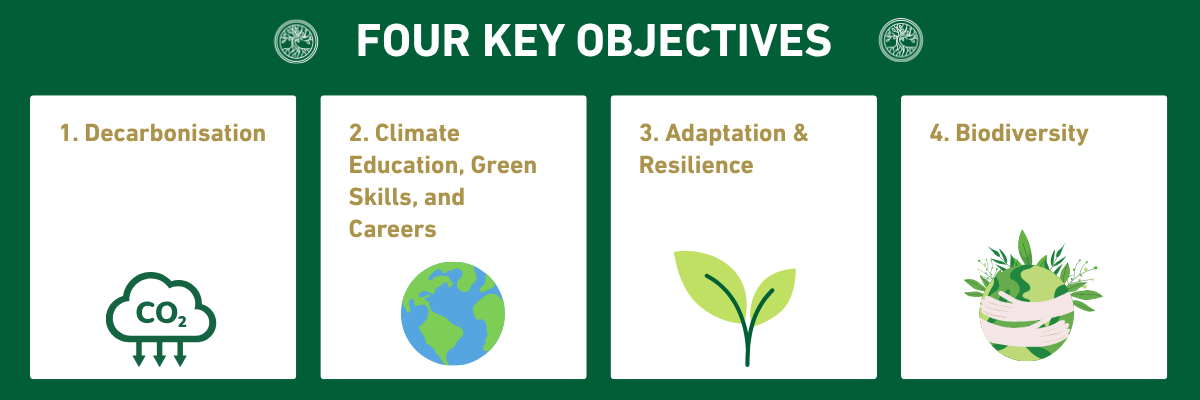
Four Key Objectives & Actions
1. Decarbonisation
Key actions for decarbonisation:
| Action | Details | Responsibility | Timeline | Stakeholder Engagement |
| Install energy monitoring systems | Use Eco Driver for gas, electricity, water | Site Teams | Year 1 | Staff, students, site teams |
| Retrofit schools | LED lighting, solar panels, low-carbon / more efficient heating | SBM/ Trust Team | Years 1–5 | Facilities, governors, suppliers |
| Behavioural change campaigns | Awareness, competitions, data sharing | Sustainability Committee in schools | Ongoing | All staff, students, parents |
| Sustainable procurement | Green supplier criteria, bulk buying | CFOO/ Business and Finance Team | Year 1+ | Suppliers, finance, governors |
| Waste management | Recycling, composting, ban single-use plastics | SBMs/ Business team, Eco Clubs | Year 1+ | Cleaners, caterers, students |
| Digital transformation | Cloud solutions, IT sustainability | Trust Business and Finance Team | Year 1+ | IT staff, teachers, students |
| Sustainable catering | Reduce food waste, increase plant-based menus | SBM.s caterers, students | Year 1+ | Caterers, students, parents |
2. Climate Education, Green Skills, and Careers
Key actions for climate education, green skills, and careers:
| Action | Details | Responsibility | Timeline | Stakeholder Engagement |
| Eco School Green Flag | Clubs, application, peer support | Sustainability Committee | Year 1 | Students, staff, parents |
| Curriculum integration | Climate topics in all subjects | Subject Leads, Committee | Years 1–3 | Teachers, students |
| Staff development | Green skills training, apprenticeships | HR, SLT | Years 1–2 | All staff, external trainers |
| Green careers guidance | Fairs, partnerships, trips |
Committee, CEAIG and Subject Leads |
Years 2–3 | Local businesses, councils |
| Partnerships | Local councils, businesses, NGOs | Committee | Ongoing | Community, parents, governors |
3. Adaptation & Resilience
Key actions for adaptation & resilience:
| Action | Details | Responsibility | Timeline | Stakeholder Engagement |
| Heat adaptation | DfE guidance, shading, playgrounds |
Site Teams SBMs Trust Business and Finance Team |
Years 1–2 | Premises, students, parents |
| Water resilience | Audits, water butts | SBMs Trust Business and Finance Team | Years 1–2 | Site teams, students |
| Flood resilience | Flood risk checks, drainage review |
Site Teams SBMs Trust Business and Finance Team |
Years 1–2 | Local authorities, site teams |
4. Biodiversity
Key actions for biodiversity:
| Action | Details | Responsibility | Timeline | Stakeholder Engagement |
| National Education Nature Park | Map schools, Climate Action Award | Sustainability Committee | Year 1+ | Students, staff, parents |
| Green spaces | Gardens, ponds, tree planting | SBM, Eco Clubs, Grounds | Ongoing | Students, grounds staff, parents |
| Student engagement | Competitions, walks, data collection | Committee, Students | Ongoing | Students, teachers |
| Community links | Local councils, wildlife trusts | Committee, | Ongoing | Community, NGOs, parents |
| Monitoring | Baseline, Eco Club data, reviews | , Eco Clubs | Year 1+ | Students, staff, governors |
Stakeholder Engagement
– Appointing Sustainability Leaders and Committees at all levels.
– Regular communication through newsletters, assemblies, and website updates.
– Involving students, staff, parents, governors, local community, and suppliers in planning and delivery.
– Annual reporting and celebration of achievements.
– Feedback mechanisms such as surveys, forums, and suggestion boxes.
Implementation & Monitoring
Leadership: Sustainability Leaders and Committee drive the plan, with the SPM coordinating procurement and communication.
Data & Review: Baseline data will be collected for all objectives. The plan will be reviewed and updated annually, with transparent reporting to all stakeholders.
Next Steps:
- Appoint Sustainability Leaders and Committee.
- Communicate the plan to all stakeholders.
- Begin baseline data collection.
- Prioritise quick wins (energy, waste, biodiversity).
- Apply for accreditations and funding.
- Review and report progress annually.
Implementation & Monitoring
Data & Review: Baseline data will be collected for all objectives. The plan will be reviewed and updated annually, with transparent reporting to all stakeholders.
Next Steps:
- Appoint Sustainability Leaders and Committee.
- Communicate the plan to all stakeholders.
- Begin baseline data collection.
- Prioritise quick wins (energy, waste, biodiversity).
- Apply for accreditations and funding.
- Review and report progress annually.